
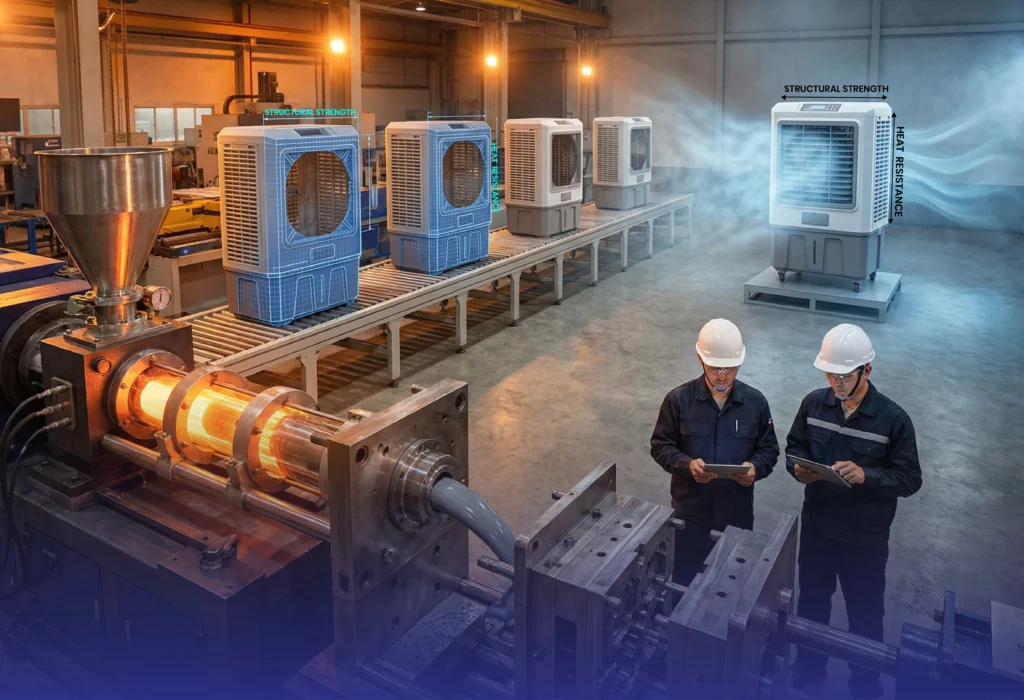
When buying an air cooler, many people instinctively judge its quality by the body material. Plastic, metal, or fiber bodies often create assumptions about cooling power, durability, and overall performance. Some believe metal coolers cool better, while others feel plastic bodies are more efficient and quieter. This raises an important question does air cooler body material actually affect cooling performance, or is it just a secondary factor? Understanding the real role of body material helps homeowners, dealers, and commercial buyers make informed decisions without falling for common myths.
Common Types of Air Cooler Body Materials
Air coolers are mainly available in three body materials: plastic, metal, and fiber (FRP). Plastic body air coolers are widely used in homes due to their lightweight design and modern appearance. Metal body air coolers are traditionally preferred for heavy-duty and commercial applications because of their strength and rigidity. Fiber or FRP body air coolers are often used in outdoor, industrial, and tent applications where durability and weather resistance are critical. Each material has unique properties, but their influence on cooling performance is often misunderstood.
How Air Cooler Body Material Interacts with the Cooling Process
The cooling process in an air cooler is driven by evaporative cooling, which depends on airflow, cooling pads, water circulation, and ventilation. Body material does not directly cool the air; instead, it influences insulation, heat absorption, vibration control, and airflow stability. A well-designed body supports smooth airflow and minimizes heat gain from the surroundings, indirectly improving cooling efficiency. Poor design, regardless of material, can restrict airflow and reduce performance.
Plastic Body Air Coolers – Performance & Characteristics
Plastic body air coolers are popular in domestic environments because plastic is a good thermal insulator. It absorbs less external heat, helping maintain cooler internal temperatures. Plastic bodies are corrosion-resistant, making them suitable for humid conditions and long-term indoor use. They also dampen vibration, resulting in quieter operation. These qualities make plastic body air coolers ideal for bedrooms, living rooms, and apartments where comfort, aesthetics, and low noise matter more than rugged strength.
Metal Body Air Coolers – Performance & Characteristics
Metal body air coolers are known for their strength and durability. Metal is rigid, which helps maintain structural stability at high airflow levels, especially in large coolers. However, metal conducts heat more easily than plastic, which can slightly increase heat absorption from the surroundings. This does not significantly reduce cooling output but may affect efficiency in extremely hot conditions. Metal body coolers are best suited for factories, warehouses, workshops, and large halls where airflow power and durability are priorities.
Fiber Body Air Coolers – Performance & Characteristics
Fiber or FRP body air coolers combine durability with thermal stability. Fiber bodies are resistant to rust, corrosion, and weather damage, making them ideal for outdoor use. They offer better insulation than metal and more strength than plastic, striking a balance between performance and durability. Fiber body coolers are commonly used in tents, pandals, events, and industrial environments where exposure to heat, dust, and moisture is unavoidable.
Does Body Material Actually Affect Cooling Output?
In practical terms, body material does not directly determine how cool the air feels. Cooling output is primarily influenced by airflow (CFM), cooling pad quality, water pump performance, and ventilation. Body material affects cooling efficiency indirectly by controlling heat absorption, vibration, and airflow stability. A well-designed plastic cooler can outperform a poorly designed metal one, proving that internal components matter far more than the outer shell.
Impact on Airflow, Noise & Comfort
Body material influences how smoothly air moves inside the cooler and how much noise is generated. Plastic bodies absorb vibrations, resulting in quieter operation and improved indoor comfort. Metal bodies can amplify vibration and noise if not properly insulated, though this is less of a concern in commercial spaces. Fiber bodies offer a balanced performance by minimizing noise while maintaining rigidity, making them suitable for both indoor and outdoor use.
Durability, Maintenance & Lifespan
Plastic body air coolers require minimal maintenance and do not rust, but they can crack if exposed to heavy impact or prolonged sunlight. Metal body coolers are extremely durable but need protective coatings to prevent rust over time. Fiber body coolers offer excellent weather resistance and long lifespan with minimal maintenance. Choosing the right material based on environment ensures better durability and lower long-term costs.
Which Body Material Is Best for Your Use Case?
For homes and apartments, plastic body air coolers are the best choice due to their insulation, low noise, and modern design. For commercial and industrial use, metal body air coolers provide the strength needed for continuous operation and high airflow. For outdoor events, factories, and harsh environments, fiber body air coolers offer superior durability and weather resistance. Matching the body material to the application delivers the best overall performance and value.
Myths vs Facts About Air Cooler Body Material
A common myth is that metal body air coolers cool better than plastic ones. In reality, cooling efficiency depends on airflow and pad quality, not body material. Another misconception is that plastic coolers are weak, whereas modern engineered plastics are highly durable for home use. Understanding these facts helps buyers focus on performance-critical features instead of assumptions.
Conclusion
Air cooler body material plays a supporting role in cooling performance rather than being the deciding factor. While plastic, metal, and fiber bodies each offer distinct advantages, true cooling efficiency depends on airflow design, cooling pads, water circulation, and ventilation. By choosing body material based on environment and usage rather than myths, buyers can enjoy better comfort, durability, and long-term value from their air cooler.