
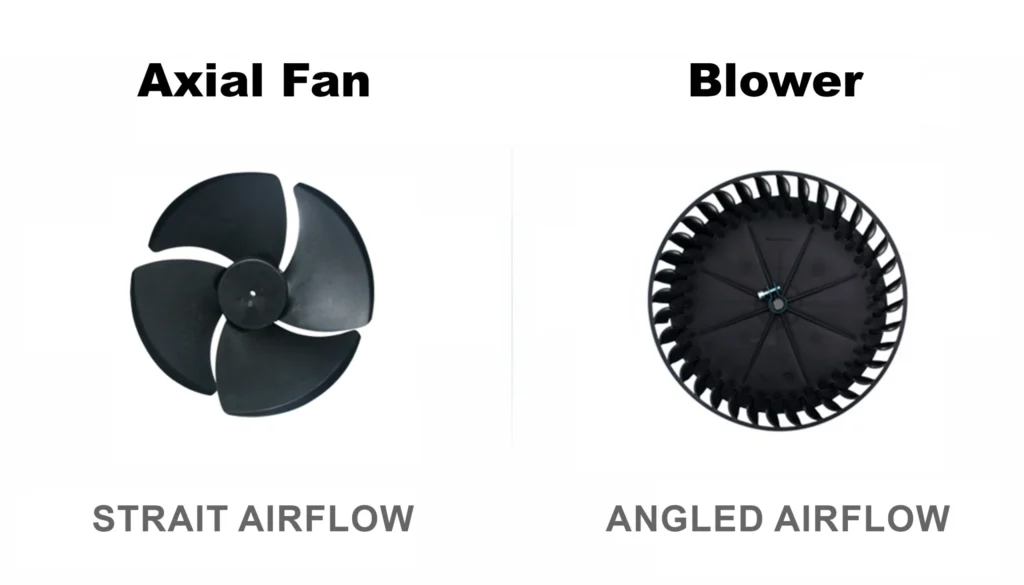
The airflow mechanism inside an air cooler plays a decisive role in how effectively it cools a space. While many buyers focus on water tank size or pad quality, the type of airflow system axial fan or blower directly impacts cooling performance, air throw, noise levels, and energy efficiency. Understanding the difference between axial fans and blowers helps homeowners, dealers, and commercial buyers select the right air cooler for their specific needs, rather than choosing based on size or price alone.
Why Airflow Design Matters in Air Coolers
Airflow design determines how air moves through the cooling pads and into the room. High airflow volume ensures wider coverage, while sufficient air pressure helps push air through dense pads, grills, or ducts. The balance between airflow volume, pressure, resistance, and throw distance affects how evenly a room cools, how comfortable occupants feel, and how hard the motor has to work. A well-matched airflow system improves cooling efficiency, reduces energy consumption, and ensures long-term reliability.
What Is an Axial Fan in an Air Cooler?
An axial fan moves air in a straight line, parallel to the axis of the fan blades. In air coolers, axial fans are designed to move a large volume of air at relatively low pressure. This makes them ideal for coolers with open designs, large cooling pads, and wide air outlets. Axial fans are commonly used in desert coolers, window coolers, and large commercial or event coolers where the goal is to circulate massive amounts of air across a large space quickly and effectively.
What Is a Blower in an Air Cooler?
A blower moves air by drawing it in and pushing it outward at a right angle using force. Instead of focusing on volume alone, blowers generate higher air pressure, allowing them to push air through dense cooling pads, narrow grills, or ducting systems. Their compact design makes them suitable for smaller or vertically slim air coolers, such as personal and tower models, where space is limited but controlled airflow is required.
Axial Fan vs Blower – Working Principle
The fundamental difference between an axial fan and a blower lies in airflow volume versus air pressure. Axial fans specialize in moving large quantities of air with low resistance, making them ideal for open environments. blowers, on the other hand, are designed to overcome resistance by generating higher pressure, allowing air to travel through tight or enclosed systems. In simple terms, axial fans are about “more air,” while blowers are about “stronger push.”
Which Type of Air Cooler Uses Which Airflow System? (Industry-Based Explanation)
Personal, mini, and compact air coolers generally use blowers because their small size and enclosed body design require air to pass through narrow cooling pads and grills. Tower coolers also rely heavily on blowers due to their slim vertical structure, which demands pressure-driven airflow for consistent cooling. Desert coolers, designed for large rooms and extreme heat, mostly use axial fans to deliver massive airflow across wide spaces. Window coolers also commonly use axial fans since they operate in semi-open conditions and benefit from high air volume. Tent, pandal, and event coolers almost always use large axial fans to cover open gatherings and large crowds. Duct coolers and air washers typically use blowers because they need to push air through long ducts and overcome static pressure.
Difference in Airflow & Air Throw Performance
Axial fans provide wide, fast-moving airflow that spreads across large areas, making them excellent for halls, factories, and outdoor events. Their air throw is long and broad but less focused. blowers offer a more concentrated airflow stream that may not cover as wide an area but delivers steady cooling in a controlled direction. This makes blowers better for rooms where airflow needs to be directed through a specific outlet or confined space.
Cooling Performance in Small vs Large Spaces
In small rooms, bedrooms, or apartments, blower-based coolers perform efficiently because they deliver steady cooling without overwhelming the space. Their focused airflow ensures comfort without excessive air movement. In contrast, axial fan coolers excel in large spaces such as living halls, workshops, warehouses, or event venues where high air volume is required to push cool air across long distances and multiple occupants.
Noise Levels & User Comfort
Noise perception differs between the two systems. blowers tend to operate more quietly at lower speeds, making them suitable for homes, bedrooms, and offices. Axial fans, due to their large blades and higher airflow, can produce more audible air movement, which is generally acceptable in commercial or industrial environments where powerful cooling is prioritized over silence.
Energy Consumption & Motor Load
Energy efficiency depends on application rather than just the airflow system. Blowers often operate at lower wattage in small coolers, reducing power consumption for domestic use. Axial fans may consume more power but deliver significantly higher airflow, making them more energy-efficient per square foot in large spaces. Choosing the wrong system for the wrong application can lead to unnecessary motor strain and higher electricity usage.
Durability & Maintenance Considerations
Axial fans have simpler mechanical construction with fewer components, which can make them durable and easier to maintain in dusty or industrial environments. blowers have more intricate designs and enclosed housings, requiring cleaner operating conditions and regular maintenance. However, when used correctly, both systems offer long service life and reliable performance.
Which Airflow System Is Better for You?
The right airflow system depends on room size, cooler type, usage duration, and environment. For compact homes, bedrooms, and apartments, blower-based personal or tower coolers are usually the best choice. For large rooms, commercial spaces, factories, or outdoor events, axial fan-based desert or tent coolers provide superior coverage. Industrial and ducted applications benefit most from blowers due to their pressure-handling capability.
Conclusion
Axial fans and blowers serve different purposes in air coolers, and neither is universally better than the other. Axial fans deliver high air volume for large, open spaces, while blowers provide pressure-driven airflow for compact or ducted designs. Understanding this difference ensures the correct pairing of airflow system with cooler type, leading to better cooling performance, comfort, energy efficiency, and long-term reliability. Making an informed choice based on airflow design is key to getting the best results from any air cooler.